0%

Choosing a colored contact lens manufacturer in 2026 means looking beyond a vivid sample card. The global contact lens market was valued at about USD 20.7 billion in 2023, with Grand View Research forecasting growth through 2030. That expansion brings opportunity, but it also makes careful supplier evaluation essential. A lens may look striking under showroom lights and feel different after hours of wear.

Professor Lyndon Jones, a leading contact-lens researcher, offers a useful principle through his published work: prioritize ocular compatibility and evidence, not appearance alone. This is a paraphrase, not a direct quotation. Buyers should examine material specifications, oxygen permeability, color consistency, production controls, and documented quality testing. Ask how the manufacturer handles a batch that fails inspection. The answer matters.

Look for records that can be checked, not promises alone. The U.S. Food and Drug Administration treats decorative contact lenses as medical devices and warns consumers against buying them without appropriate professional oversight. Requirements differ by market, so confirm the rules where products will be sold. A reliable colored contact lens manufacturer should explain its quality systems clearly, provide current documentation, and answer technical questions without evasion. Some details may still need independent verification. That is normal—and worth doing before a large order.
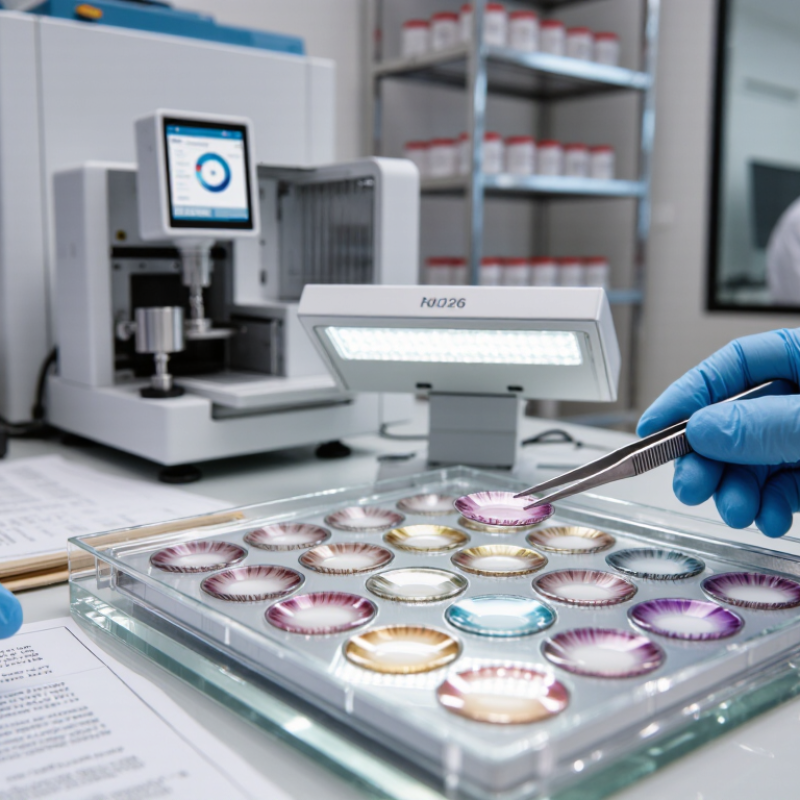
How to Choose a Colored Contact Lens Manufacturer in 2026?

Define Product, Market, and Compliance Requirements

Before comparing manufacturers, define the lens you actually need. Is it cosmetic, corrective, or both? Specify the intended wear schedule, replacement interval, prescription range, base curve, diameter, and material. Ask for sample lenses and inspect color consistency under daylight and indoor lighting. Small details matter. A shade that looks subtle in a product photo may appear much stronger on different eye colors.

Then define the markets you plan to serve and check the applicable requirements for each one. Contact lenses are regulated products in many markets, and rules can differ. Confirm what evidence, quality controls, labeling, and traceability records are required before requesting a production quote. Packaging should clearly communicate wear and care instructions, and claims should match the product’s permitted use. A manufacturer’s general assurance is not a substitute for reviewing current requirements with a qualified regulatory professional.

Put these expectations into a written specification: target quantities, acceptable color variation, testing records, packaging details, and delivery conditions. Ask how the manufacturer handles rejected batches and production changes. Be cautious if answers stay vague. One easy mistake is treating a low sample cost as proof of reliable quality; it is not. Requirements may also change as your market plan develops, so revisit the specification rather than assuming the first draft is complete.

Verify Licenses, Safety Standards, and Quality Systems

How to Choose a Colored Contact Lens Manufacturer in 2026?

Before discussing colors or packaging, verify that the manufacturer holds current licenses for its actual production site and product category. Check details with the issuing authority where possible; a certificate image alone may be outdated or incomplete. Confirm that the company name, address, and approved activities match the supplier you are evaluating.

Not enough.

Tips: Ask for copies of relevant safety certificates, recent audit findings, and test reports. Check dates and product names. Ask which standards apply in your intended market, and how the manufacturer assesses material safety and lens performance. Vague answers deserve follow-up.

A reliable quality system should track each production batch from raw materials to finished lenses. Ask how staff handle failed inspections, customer complaints, and product recalls. Request an example of a corrective action, with sensitive details removed, and see whether the response identifies a cause and checks that the fix worked. It is easy to overvalue polished paperwork; real systems show their strength in routine records and clear answers. No document guarantees every lens will be flawless, so look for consistent evidence rather than one impressive certificate.

Assess Lens Design, Materials, and Manufacturing Capabilities

A colored lens should be assessed as an optical device, not just a color sample. Ask how the pigment is enclosed, whether it stays clear across the pupil, and how the design affects oxygen transmission. For soft lenses, compare material, water content, oxygen permeability, and lens thickness together; no single specification tells the whole story. Small details matter. Request test data for the finished lens, not only raw material sheets.

Manufacturing capability is visible in repeatability. Ask for documented controls on molding, pigment placement, edge finishing, sterilization, and batch inspection. Check whether the manufacturer can share traceability records and explain how it handles out-of-spec results.

The CDC’s 2014 MMWR survey found that 99% of surveyed U.S. contact lens wearers reported at least one risky hygiene behavior. That finding does not indicate factory failure, but it underscores why clear handling guidance and consistent product quality matter.

Evaluate samples under realistic conditions: different lighting, a moving eye, and several production lots. A polished prototype can hide variation. I would not choose a supplier from one attractive sample; that is an imperfect shortcut. Compare measured parameters with independent test reports, and ask who performed each test. A capable manufacturer should explain limitations plainly, including where a design may not suit every wearer. (CDC, MMWR, 2015)

Compare Minimum Orders, Pricing, Lead Times, and Support

A low minimum order can help you test a new color range without filling a warehouse. Compare the MOQ for each lens design, not just the overall order. Ask whether sample runs, custom packaging, and repeat orders have separate minimums. Get a written quote showing unit price, setup charges, packaging, and freight. A low quote may exclude important costs. Check how prices change at different quantities, and confirm the quote’s validity period. Ask for product specifications and quality documentation, including material details and batch traceability. Small orders still need careful review.

Lead times should cover more than manufacturing. Ask for separate estimates for sample approval, production, quality release, and shipping. Then add a buffer for delays; a promised date is not always a delivery date. In practice, a spreadsheet rarely shows every handoff. Request a timeline with clear checkpoints, especially before a seasonal launch.

Support matters when a shipment arrives late or a batch needs investigation. Find out who handles technical questions, what records they can provide, and how quickly they respond. For colored lenses, request evidence of applicable quality controls and clear instructions for storage and handling. Have a qualified eye-care professional review product and fit considerations. A fast reply helps. Still, vague answers about testing or traceability deserve follow-up. Ask how problems are documented and resolved before placing a larger order.

How to Choose a Colored Contact Lens Manufacturer in 2026?

Suggested evaluation weights for comparing minimum orders, pricing, lead times, and support.

These weights are a practical starting framework, not industry survey results. Adjust them to your order volume and priorities, and compare like-for-like product specifications, written quotes, delivery estimates, and support terms.

Evaluate Samples and Select a Manufacturing Partner

A colored lens sample should be judged on the eye, not only under bright showroom lights. Check color consistency, edge finish, lens flexibility, packaging seals, and the clarity of its instructions. Ask for samples from more than one production batch; a single perfect pair proves little. Request documented checks for dimensions, optical power, and surface defects, plus traceability records linking each sample to its batch. Have a qualified eye-care professional assess fit and vision. Comfort is useful feedback, but it is not a quality test by itself.

The CDC’s 2017 MMWR report found that 99% of surveyed contact lens wearers reported at least one risky care behavior. That figure concerns wearers, not factories, but it highlights why clear care guidance matters. Ask the manufacturer how instructions are reviewed, how complaints are logged, and what happens when a batch fails inspection. Verify that its quality system and test methods are independently documented. A polished sample can still hide weak follow-up. I would want to see the records.

Tips: Compare samples in daylight and indoor light. Keep dated photos and batch details. Ask for written answers, not promises. If the manufacturer cannot explain a defect investigation clearly, pause before placing a large order.

How to Choose a Colored Contact Lens Manufacturer in 2026? — Evaluate Samples and Select a Manufacturing Partner

Use this evidence-based scorecard to compare potential manufacturing partners. Request current, market-specific documents and assess production samples alongside quality, compliance, and supply capabilities.

Evaluation Dimension Weight What to Evaluate Evidence to Request or Check Sample or Audit Check
Regulatory Readiness 20% Confirm that the proposed lens, intended use, labeling, and manufacturing site are addressed for each target market. Requirements differ by jurisdiction. Current market-specific authorizations or conformity documents, device and site details, labeling examples, and a written explanation of applicable requirements. Verify documents with the relevant regulator or issuing body where possible. Check that the sample’s product identity and labeling match the documents. Do not treat a registration or listing by itself as proof of product approval or authorization.
Quality Management System 15% Assess whether documented procedures cover design and process changes, supplier control, nonconforming product, corrective actions, complaints, and traceability. Current quality-system certificate and scope, audit summary, change-control procedure, corrective-action records, and a sample batch record. Confirm the certificate’s validity and covered site. Trace a sample lot from incoming materials through production, inspection, release, and distribution using anonymized records.
Sample Fit, Comfort, and Visual Performance 20% Evaluate the agreed parameters, edge finish, tint appearance, print or color consistency, handling, and wear performance under an appropriately supervised evaluation. Samples from more than one production lot, specifications for base curve, diameter, power range, and material, plus the manufacturer’s inspection criteria. Compare samples under consistent lighting and conditions. Have qualified eye-care professionals assess fit and safety; appearance alone cannot establish suitability or safety.
Material and Performance Data 10% Review the stated lens material and relevant performance characteristics, such as oxygen transmissibility, water content, and dimensional stability, where applicable to the product. Material specifications, test methods, test reports, and evidence that the reported data apply to the exact lens design and material being offered. Check that the sample, technical specification, and test documentation identify the same product version and material.
Manufacturing Consistency 10% Determine how the manufacturer controls critical dimensions, cosmetic appearance, and lot-to-lot variation, including color and pattern consistency. Inspection plan, acceptance criteria, process-monitoring records, lot-release results, and procedures for handling out-of-specification results. Compare coded samples from different lots against agreed specifications. Ask how defects are identified, recorded, and prevented from recurring.
Sterilization and Packaging Controls 10% For products supplied sterile, assess sterilization validation, routine monitoring, packaging integrity, and controls supporting the stated shelf life. Sterilization validation and routine-release documentation, packaging specifications, seal-integrity test information, and shelf-life support for the offered configuration. Inspect packaging condition, labeling, lot identification, and expiry details. Request relevant integrity or stability evidence rather than relying on visual inspection alone.
Customization and Change Control 5% Clarify available options for color, pattern, parameters, packaging, and labeling, and understand how changes are reviewed and approved. Written product specification, sample approval process, tooling or artwork controls, minimum order quantities, and formal change-notification terms. Approve a documented reference sample and specification. Confirm that production changes require notification and written approval where contractually agreed.
Supply Reliability 5% Review capacity, lead-time assumptions, continuity planning, and the manufacturer’s ability to manage forecast changes and supply interruptions. Written production lead times, capacity-planning approach, business-continuity plan summary, and order-status escalation process. Compare stated lead times with documented recent performance where available; define service expectations in the supply agreement.
Communication and Technical Support 5% Assess response quality, document control, issue escalation, and support for technical or quality questions. Named role-based contacts, response and escalation process, document revision controls, and examples of issue-investigation reports with confidential details removed. Use a written sample or specification review to assess whether answers are complete, consistent, and supported by records.
Total 100% Score each dimension from 1 to 5, where 1 = inadequate evidence, 3 = acceptable with gaps, and 5 = strong, verified evidence. Weighted points = dimension score ÷ 5 × weight. Compare total scores only after addressing any critical regulatory, quality, or safety gaps.
Decision reminder: Colored contact lenses are medical devices in many markets, including lenses marketed for cosmetic use. Confirm current local requirements and use qualified regulatory and eye-care professionals for market-entry and clinical decisions. A good sample does not replace regulatory verification, quality-system review, or production-lot controls.

FAQS

What details should I define before requesting a quote?

Specify lens purpose, wear schedule, replacement interval, prescription range, base curve, diameter, and material. Set target quantities and acceptable color variation. Small details matter.

How should I assess lens color samples?

Compare samples in daylight and indoor lighting. Check them on different eye colors when possible. A shade can look stronger in person.

What market requirements should I confirm?

Check each destination market’s current requirements for testing, quality controls, labeling, and traceability. A qualified regulatory professional can help review them. Rules may change.

How can I verify a manufacturer’s certificates?

Confirm that licenses cover the actual production site and product category. Check the company name, address, approved activities, dates, and product names with the issuing authority where possible. A certificate image alone is not enough.

What should I ask about quality control?

Ask how each batch is tracked, how failed inspections are handled, and how complaints or recalls are managed. Request a documented corrective-action example with sensitive details removed. Look for routine records.

How many samples should I evaluate?

Ask for samples from more than one production batch. Check color consistency, edges, flexibility, packaging seals, and instructions. One sample proves little.

What testing records should I request?

Request documented checks for dimensions, optical power, and surface defects. Ask for traceability records linking each sample to its batch. Have a qualified eye-care professional assess fit and vision.

Why do clear care instructions matter?

Poorly explained care guidance can leave wearers unsure what to do. Ask how instructions are reviewed and how complaints are logged. Comfort feedback helps, but it is not a quality test. I would still want to see the records.

Conclusion

Choosing a colored contact lens manufacturer in 2026 starts with defining your product, target market, and applicable compliance requirements. Clarify the lens styles, materials, design features, packaging, and production volume you need. Then verify that potential partners hold appropriate licenses, follow relevant safety standards, and maintain consistent quality-control systems. Ask how they manage inspections, documentation, and traceability throughout production.

Next, assess whether each manufacturer has the design expertise, materials, equipment, and capacity to meet your specifications. Compare minimum order quantities, pricing, lead times, communication, and after-sales support—not just the initial quote. Request samples and evaluate their appearance, comfort, consistency, and packaging against your requirements. By comparing these factors systematically, you can choose a reliable manufacturing partner that fits your product goals and supports a smooth, well-managed production process.

Amelia

Amelia

Amelia is a marketing professional who brings a thoughtful, informed perspective to the company’s work. With a strong understanding of its products, she regularly researches customer needs, product features, and practical applications to create clear, useful articles for the company website. Her......