0%

Choosing a contact lens supplier in 2026 takes more than comparing prices. The right partner should provide consistent products, clear documentation, and dependable communication. Small details matter. Can the supplier explain its quality checks, provide batch information, and respond clearly when a shipment is delayed? Ask for current product specifications and documentation relevant to your market. Check that packaging, labeling, and delivery terms match your business needs. A polished website is not proof of reliability.

Compare suppliers using the same practical checklist. Review sample quality, order minimums, lead times, return procedures, and support for product complaints. Confirm how the supplier handles traceability and changes to product specifications. For retail or clinical settings, coordinate product selection with qualified eye care professionals; supplier claims alone are not a substitute for professional guidance. Request references where appropriate, and check whether answers remain consistent across sales and service teams. That sounds tidy. It rarely is. A supplier may score well on price but fall short on communication or stock continuity. Record the trade-offs, verify key claims, and avoid rushing into a long-term agreement. The best choice is not automatically the largest company or the cheapest quote. It is the supplier whose evidence, service, and capabilities fit your needs—and whose limits are clear.
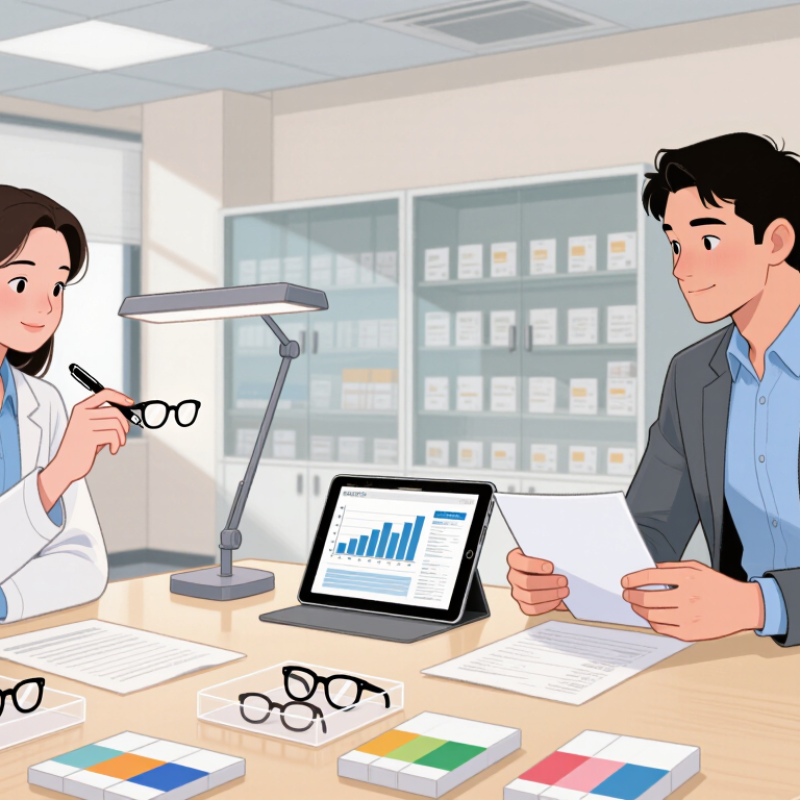
How to Find the Best Contact Lens Supplier in 2026?

Size Demand Using CDC’s Estimate of 45 Million U.S. Contact Lens Wearers

How to Find the Best Contact Lens Supplier in 2026?

CDC estimates that about 45 million people in the United States wear contact lenses. Treat this figure as a market-sizing reference, not a guaranteed customer count for your business. Your reachable demand depends on location, customer preferences, prescription needs, and how often people replace their lenses. A national estimate cannot tell you which products will move from your shelves. That takes local research.

Before choosing a supplier, compare its available lens types, replacement schedules, minimum order quantities, and restocking times. Ask how it handles backorders and product information. These details matter when a customer needs a specific lens and your usual stock runs low. A large number can mislead. Use sales records, customer inquiries, and local demographic data to estimate demand by product category. Then check whether the supplier can support that mix without tying up too much cash in slow-moving inventory. Your first forecast may be imperfect; review it regularly and adjust.

Tips: Start with a modest order and track which products customers request. Confirm delivery timelines and return conditions in writing. Keep a simple record of stockouts, too. Missed requests can reveal demand that sales totals alone may hide.

How to Find the Best Contact Lens Supplier in 2026?

Size demand using the CDC’s estimate of 45 million U.S. contact lens wearers

The CDC estimates that about 45 million people in the United States wear contact lenses, and reports that nearly two-thirds are women. The chart translates those rounded figures into an approximate split of 30 million women and 15 million other wearers. Use this population estimate as a demand-sizing baseline; it is not a forecast of units sold or supplier capacity.

Source: U.S. Centers for Disease Control and Prevention (CDC), contact lens use estimates.

Screen FDA Device Classification, Required Clearances, and ISO 13485 Systems

When evaluating a contact lens supplier, start with the exact device, not a broad product category. Ask for its intended use, material, model number, and FDA product code. Classification can depend on device details. Many conventional contact lenses are Class II devices, but confirm the specific listing and applicable requirements in FDA records. A supplier’s registration or device listing is not the same as FDA clearance.

Ask for the relevant 510(k) clearance information when required, then match the cleared device and manufacturer to the product being offered. Check names and model details carefully. Small differences matter. If a supplier cannot explain who holds the clearance or provide traceable documentation, pause and seek clarification. I would not treat polished paperwork as proof on its own; records can be incomplete or outdated.

ISO 13485 certification offers evidence of a quality management system, not automatic approval for a particular lens. Review the certificate’s validity, covered sites, and scope. Does it include the activities involved in making or supplying the lens? Also ask how the supplier controls batch records, complaints, and changes to materials or manufacturing. A clear answer should lead to verifiable documents, such as sample lot records and a change-control procedure. Some answers may still feel vague. That is a reason to ask again, not to guess.

How to Find the Best Contact Lens Supplier in 2026? - Screen FDA Device Classification, Required Clearances, and ISO 13485 Systems
Evaluation Area What to Confirm Evidence to Request 2026 Screening Standard Common Warning Sign
Product classification Identify the exact device type, intended use, material, wear schedule, and FDA product code. Contact lenses are generally Class II medical devices; decorative lenses are also regulated as medical devices, even when they have no vision-correction power. Product specifications, intended-use statement, labeling, and the matching FDA classification-database entry. Verify product by product. Confirm the classification and applicable regulation in FDA’s Product Classification Database rather than relying on a generic supplier statement. A supplier describes decorative lenses as cosmetics or claims that all lens designs follow the same regulatory pathway.
Premarket pathway Determine whether the specific lens requires a 510(k), is exempt from 510(k), or has another applicable pathway. Requirements depend on the device type and applicable FDA rules. For a 510(k) device, the FDA clearance letter and 510(k) number; for an exemption claim, the precise regulatory basis and confirmation that the device remains within the exemption’s limits. Match the evidence to the exact product. Check the FDA record for the legal manufacturer, device description, intended use, and relevant models. A supplier presents a registration, listing, ISO certificate, or foreign-market certificate as proof of FDA clearance.
FDA establishment registration and device listing Check whether the relevant establishments and devices are registered or listed when required for their role and product. Current registration/listing details and the names and addresses of the legal manufacturer and manufacturing sites. Use FDA records as an identity and listing check. Registration and listing do not mean FDA has approved or cleared a device. The supplier calls an FDA establishment registration “FDA approval,” or the listed entity does not match the product documentation.
Legal manufacturer and supply-chain roles Establish who designs, manufactures, sterilizes, packages, labels, imports, and releases the finished device. Confirm who holds regulatory responsibility for each activity. Quality agreement, manufacturing-site list, role and responsibility matrix, and change-notification process. Ensure the named manufacturer and sites align with regulatory records, technical documentation, and the actual production chain. Unexplained subcontracting, undisclosed site changes, or unclear responsibility for product release and complaints.
ISO 13485 quality-management system Assess the quality system covering design and development, production, traceability, purchasing controls, nonconformities, corrective actions, and complaint handling, as applicable to the supplier’s role. Current ISO 13485:2016 certificate, scope, covered site addresses, certification-body details, and recent audit or corrective-action summaries where available. Verify scope, site, and validity. ISO 13485 certification is useful evidence of a quality system; it is not FDA product clearance and does not replace regulatory obligations. The certificate is expired, excludes the manufacturing site or relevant activities, or is offered as the sole proof of FDA compliance.
FDA QMSR readiness For U.S. device activities, determine how the supplier’s quality system addresses FDA’s Quality Management System Regulation (QMSR). Documented QMSR gap assessment, implementation status, training records, and relevant controlled procedures. FDA’s QMSR became effective on February 2, 2026, incorporates ISO 13485:2016 by reference, and applies to covered manufacturers. A third-party ISO certificate is not itself an FDA-issued certificate. The supplier assumes an ISO certificate alone demonstrates full compliance with every applicable FDA requirement.
Biocompatibility and material controls Review safety evidence for materials that contact the eye, including the lens material, colorants, surface treatments, and relevant manufacturing residues. Biocompatibility rationale and test summaries, material specifications, supplier controls, and change-control records. Evidence should reflect the finished device, intended contact, and applicable FDA-recognized standards or guidance where relevant. Testing relates only to a raw material or a different product, with no documented rationale for applying it to the finished lens.
Sterility, packaging, and shelf life Confirm the product’s labeled sterility status, packaging integrity, sterilization controls where applicable, and supported expiration date. Sterilization validation or justification, package-integrity evidence, lot-release criteria, and shelf-life or aging data appropriate to the product. Check that package labeling, storage conditions, and lot documentation are consistent with the product’s regulatory documentation and intended use. Unsupported shelf-life claims, inconsistent sterility statements, or missing lot-level release records.
Labeling and prescription controls Review U.S. labeling, fitting and use instructions, warnings, lens parameters, and applicable prescription requirements. Contact lenses, including decorative lenses, are prescription medical devices in the United States. Current U.S. labeling and instructions for use, approved or cleared labeling where applicable, and documented labeling-change controls. Confirm that product claims and intended use match the applicable FDA record and that distribution processes respect prescription requirements. Claims differ from the cleared or documented intended use, or decorative lenses are marketed as unrestricted over-the-counter cosmetics.
Traceability, complaints, and recalls Assess the supplier’s ability to trace finished lots to materials and sites, investigate complaints, report relevant events, and support field actions. Sample lot-traceability records, complaint and escalation procedures, recall plan, and corrective-action examples with confidential details removed. Test the process. Request a mock trace exercise that identifies affected lots and the distribution path within a documented timeframe. Records cannot connect a finished lot to its production site, key inputs, release decision, or downstream distribution.
Supplier change control Confirm advance notification and regulatory assessment for changes to materials, design, manufacturing process, sterilization, packaging, labeling, or manufacturing sites. Change-control procedure, notification timelines, and examples of documented impact assessments. Changes should be assessed for quality and regulatory impact before implementation, including whether a new FDA submission or other action may be required. Changes are made without notice or are treated as administrative even when they could affect safety, performance, or regulatory status.
Overall supplier decision Combine regulatory identity checks, quality-system evidence, product-specific safety documentation, and operational capability. Completed supplier audit or assessment, open-issue log, quality agreement, and approved-product/site list. Preferred: Product-specific regulatory evidence, a verified quality system, transparent manufacturing roles, reliable traceability, and documented change control. Do not approve based on certificates alone. Resolve mismatched records, unsupported claims, and unclear regulatory responsibility before sourcing.

Audit Traceability and Risk Controls Against ISO 14971 Requirements

How to Find the Best Contact Lens Supplier in 2026?

Audit Traceability and Risk Controls Against ISO 14971 Requirements

A supplier audit should follow a lens from material receipt to sealed carton. Request polymer batch records, production dates, inspection results, sterilization records, and release approvals. Check that each lot can be traced forward to customers and backward to its inputs. Small details matter. A lot code that cannot be reconciled across records weakens recall readiness. ISO 14971:2019 calls for identifying hazards, estimating and evaluating risks, and applying risk controls across a device’s life cycle. It is a risk-management standard, not a supplier scorecard. Ask how the supplier assesses risks from contamination, packaging failure, and process changes, and whether controls are verified.

Use evidence, not polished promises. The CDC estimated about one million U.S. outpatient and emergency visits for keratitis each year, with roughly $175 million in direct healthcare costs; the estimate appeared in a 2015 MMWR report. That burden does not prove a supplier caused infections, but it shows why process control matters. Review complaint trends, investigation timelines, corrective actions, and whether recurring issues trigger updated risk assessments. Compare change-control notices with actual production records. Paper is not proof. A clean audit file can still conceal a weak handoff between manufacturing and quality teams. Ask to sample a recent lot and trace it yourself. Note any gaps, even small ones, and agree on evidence and deadlines for closing them.

Compare Capacity, Lead Times, and Recall Readiness with Your Forecast

Choosing a contact lens supplier in 2026 means testing real capacity against your forecast, not a glossy maximum-output figure. The CDC estimates that about 45 million people in the United States wear contact lenses (CDC, “About Contact Lenses”). That figure does not predict your product mix, but it shows why supply gaps matter. Request monthly capacity by lens type, current utilization, and evidence that packaging and sterilization can handle peak weeks.

Tips: Compare quoted lead times with recent order records, not just standard terms. Ask how suppliers manage delays in materials or production, and whether they can share on-time delivery data. Forecasts are never perfect. Include a small demand shift in your review, such as a sudden increase in one prescription range.

Recall readiness deserves the same scrutiny as price. FDA’s 21 CFR Part 7 recall guidance outlines procedures for evaluating and conducting recalls. Ask whether the supplier can trace each lot through production and distribution, provide contact records, and support a mock recall. Measure how quickly it identifies affected lots and reconciles shipped quantities. A polished procedure is not enough; test the records. If the supplier cannot explain a weak result, treat that as a gap to resolve before relying on its forecast commitments.

Score Total Cost, Service, and Compliance Before Selecting a 2026 Partner

How to Find the Best Contact Lens Supplier in 2026?

Score Total Cost, Service, and Compliance Before Selecting a 2026 Partner

A low unit price can hide freight charges, minimum order quantities, short-dated stock, or costly returns. Score suppliers across three areas: total cost, service, and compliance. A 100-point scorecard might assign 40 points to cost, 30 to service, and 30 to documentation. Adjust the weights to fit your market and order volume. No scorecard replaces judgment.

The CDC’s 2015 Morbidity and Mortality Weekly Report estimated nearly one million outpatient and emergency visits for keratitis annually, with about $175 million in direct healthcare costs.

This figure does not measure supplier-related failures. It does show why product handling and traceability deserve attention. Request lot records, market-specific registration and labeling documents, a written recall process, and a clear complaint contact. Verify the paperwork; a broad “compliant” claim is not evidence.

Compare landed costs, not just quoted prices. Include shipping, payment terms, replacement policies, and potential expiry waste. Test service with a small order: record delivery accuracy, response time, and how the supplier handles a backorder or damaged shipment. Ask who owns urgent issues and when you should expect a reply. Small details matter. The process can still feel imperfect, especially when markets require different documents, so verify requirements for each destination before signing.

FAQS

Does the estimate of 45 million contact lens wearers predict my sales?

No. It is a national reference, not a customer count for your business. Local demand depends on prescriptions, preferences, and replacement schedules.

How can I estimate demand for specific lens types?

Review sales, customer requests, and local demographic data by product category. Track stockouts, too. A missed request may reveal demand that sales totals hide.

What should I compare when choosing a supplier?

Check lens types, order minimums, restocking times, and return conditions. Ask how backorders are handled. Get delivery estimates in writing.

What product details should I request?

Ask for the intended use, material, model number, and applicable product information. Match documents to the exact lens offered. Small differences matter.

Does supplier registration prove that a lens has clearance?

No. Registration or device listing is not the same as clearance. Check the relevant records and confirm that they match the device and manufacturer.

What does ISO 13485 certification tell me?

It indicates a quality management system, not automatic approval for a particular lens. Review the certificate’s validity, covered sites, and scope.

How can I check whether a supplier can meet my forecast?

Request monthly capacity by lens type, current utilization, and recent delivery data. Compare quoted lead times with actual order records. Forecasts are imperfect.

How should I assess recall readiness?

Ask whether each lot can be traced through production and distribution. Request sample records and a mock recall. Test how quickly quantities reconcile.

What is a sensible first order?

Start modestly and track requests, sales, and stockouts. My first forecast may be wrong. Review it regularly, then adjust.

Conclusion

Choosing the right contact lens supplier in 2026 starts with understanding demand. Use the estimate of 45 million U.S. contact lens wearers as a reference point, then build a forecast that reflects your market, product mix, and expected growth. Next, verify that potential suppliers understand the relevant FDA device classifications and required clearances, and can demonstrate quality systems aligned with ISO 13485. A reliable supplier should also provide clear product traceability and risk controls consistent with ISO 14971 principles.

Compare each candidate’s production capacity and lead times with your forecast, and ask how it prepares for and responds to a product recall. Finally, evaluate the full relationship—not just the quoted price. Consider total cost, communication, service, documentation, and ongoing compliance support. A structured comparison of these factors can help you select a partner that meets current needs while remaining dependable as demand changes.

Evelyn

Evelyn

Evelyn is a professional marketing specialist with a strong understanding of the company’s products, customer needs, and the practical considerations that shape purchasing decisions. Through regular contributions to the company website, Evelyn shares clear, informative blog articles that help......